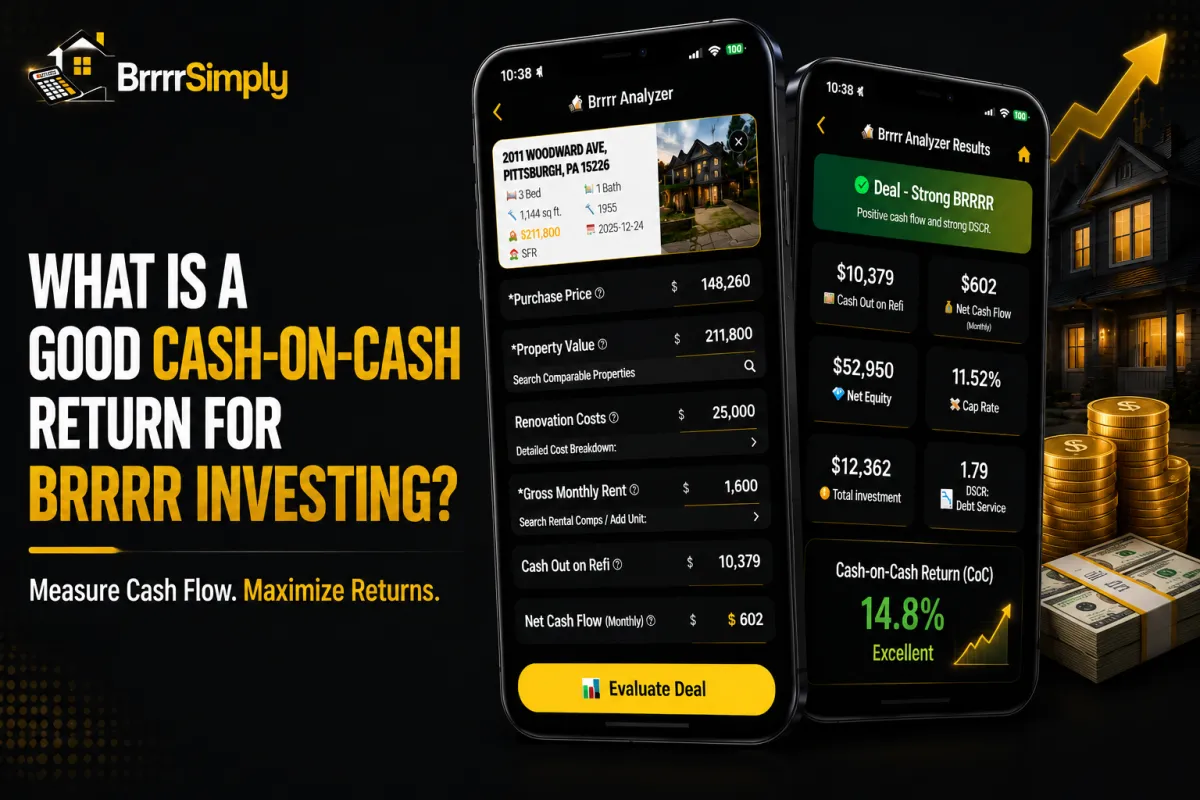
What is a Good Cash-on-Cash Return for BRRRR Investing
If you ask ten BRRRR investors for their expected return on investment, you will get a different answer each time. For example, some would insist that returns under 15% are not even worth considering. Others might claim that a 9% ROI would be perfectly acceptable, provided it was in the right neighborhood. Finally, someone would brag about infinite return, as if the number alone tells the story.
Not necessarily. Cash-on-cash (CoC) is one of the essential ratios for investors when evaluating the deal, but it is perhaps one of the easiest to misinterpret. Choosing a poor benchmark or focusing exclusively on the percentage itself will likely lead to making an excellent deal that won't generate any cash flow whatsoever.
Here's everything you need to know about the CoC return ratio, including its definition, optimal range, and common pitfalls.
What Does Cash-on-Cash Return Mean?
Cash-on-cash return lets you know how much annual cash flow you are getting in relation to the actual cash you are using in a deal. This is not return on the purchase price. This is not return on the equity. Cash-on-cash return is all about the amount of cash you are receiving based on how much cash you put in your investment.
Formula
CoC Return % = (Annual Net Cash Flow ÷ Cash Left in Deal) × 100
On a regular rental deal, cash left in the deal refers to the total sum of down payment, closing costs, and rehab costs. On BRRRR, however, the amount of cash left in the deal becomes minimal after a refinance, which results in the investor receiving a negative amount for his CoC calculation.
Imagine that you have finished a BRRRR project, and there is still $12,000 remaining in your equity after doing a cash-out refinance, while your yearly cash flow for this investment was equal to $2,160. In this case, your CoC return will be 18%. Now imagine a situation where your yearly cash flow is still the same, but there is only $3,000 left after the refinancing. Your return on the investment will now be 72%.
As you can see, this metric is very sensitive to how successfully you can pull off the financing part of the process.
CoC Target Ranges for Experienced BRRRR Investors
There is not a single correct number when it comes to the CoC. Markets, financing, and individual risk profiles will move that number around. However, the general ranges for experienced BRRRR investors are:
With expensive coastal markets where costs are higher, you might see an 8-12% return because property values squeeze every return metric. But if you're operating in a Midwest or Southern market where entry points are cheaper, then you should hit the 15-20%+ mark. This is because these cheaper entry points will allow for easier capital recycling and cash flows.
The figure that really counts isn't necessarily an absolute industry standard. It is rather the number that beats out your alternative use of capital, while providing enough margin to cover risks and even some slow months here and there.
Why an Infinite Return Sounds Better Than It Sometimes Is
An infinite CoC return is one where your refinance comes back at 100% (or above) of your all-in investment amount. This means that you essentially have no money left in the deal, which results in dividing a positive cash flow by zero, yielding an infinite ratio.
This is the dream scenario that all BRRRR investors strive to achieve because you would not only have covered all your initial capital expenses, but you also would be able to keep the asset that generates ongoing income for you. With that cash flow, you could repeat the same process with your next buy.
Remember, however, that an infinite ratio doesn't say anything about how much actual money you'll earn. Even if your cash flow from the recycled property only amounts to $60 per month, you'd be doing everything as expected, although the income you would have earned would be rather small. In other words, infinity multiplied by nothing remains nothing.
The Misleading Side of Cash-on-Cash Return
This is the kind of situation that catches out many beginners. You crunch the numbers, put aside just $1,000 in the transaction after you refinance, and get $100 per month from the property. So that's a cash-on-cash return of 1,200 percent on an annual income of $1,200 from an investment of $1,000. Sounds like one of the better investments anybody has ever made.
However, $100 per month doesn't cover even one unforeseen expense. An emergency plumbing bill will consume the cash flow from that property for an entire year before you know what happened.
Compare this to another scenario where you put in $15,000 after a refinance and make a net income of $350 a month, or $4,200 a year. This would yield a 28% Cash-on-Cash return. This is a smaller return when compared to the earlier case, but in terms of money going into your pockets monthly, it's three times bigger and best suited for any rental-related issues.
It cannot be determined that one investment is better than the other based on just the percentage. Both of these helps you make an informed decision about the deal.

Cash-on-Cash Return (CoC) Return & Cash Flow
This is the best approach used by experienced BRRRR real estate investors, setting a floor for both numbers, not just one.
The most typical combination goes something like this: aiming for a CoC return of 12-15% and a cash flow of $200-300 per door per month. If your deal passes both metrics, it is a good one. If it fails to pass one of them, you may want to explore why it is so and whether you have any negotiating power when it comes to the failing metric (lower price, smaller rehab, etc.).
The two-metric approach helps protect from a different type of mistake. This involves turning down a good deal simply because the numbers look unimpressive, even though the dollar amount is solid. A property that leaves you with $20,000 in the deal but yields $300 a month results in a CoC of 18%, which falls squarely in the good range.
Other Factors That Can Impact Your Target
A couple of factors might affect how high your personal CoC target needs to be.
The structure of your loans is significant. Refinancing your property with an increased interest rate will impact your monthly cash flow and reduce both of them. Do not expect to get a great loan rate just because a lender said so; always work with real-life numbers.
The dynamics of your market rent play a role as well. If your market has positive long-term growth rates for market rents, this might allow you to accept a lower CoC today since future cash flows should increase.
Tenant quality and management requirements impact CoC expectations. Properties that require active management or have high turnover rates need to adhere to a stricter CoC requirement, as they will end up costing you more time, vacancy, and repair expenses than what is shown on paper when analyzing the property.
The limits of your own capital matter. When considering a property that has already used up much of your capital and you can no longer make new investments without refinancing, a property that recycles your full capital amount, even with lower raw cash flows, is a better investment than properties with higher cash flows.
Perform Accurate Calculation without Guesswork
This is where most people find the issue. They know what goes into the formulae but can never get them right without emotion clouding their judgment since they don't use realistic numbers in their calculations and are bound to underprice rehab and overestimate rent while overstating the potential for refinancing.
BrrrrSimply's BRRRR Calculator has been developed by investors who have closed over 2,500 transactions and built-up portfolios totalling over 950 units. It does everything from determining your overall investment to cash-on-cash ROI in less than 60 seconds.

Conclusion
There is no universal cash-on-cash return that makes a good BRRRR deal. It depends on what works for your market and your risk management strategy, combined with the cash-flow floor, which is the point at which the investment remains valuable regardless of percentages. The sweet spot lies within the 12-20% range if you can hit it, and if not, make sure you aim for an infinite return because that is what should remain your objective.