
A Step-by-Step Guide to Analyze a BRRRR Deal
If you have spent time across real estate investing landscape, you may have heard the term BRRRR.
Buy. Rehab. Rent. Refinance. Repeat. IT sounds simple and clear, and honestly, when you accurately run the numbers, it powers up your BRRRR strategy that help turn everyday investors into portfolio-scaling machines. But the word ‘accurately’ carries a huge weight. It’s a caution for those investors who ignore BRRRR deal analysis before making the purchase. In such scenario, the investors end up holding a property they can’t refinance, with cash tied up in first deal they can’t recover. So, it’s very important that how well you analyze a BRRRR deal before you make buying decision.
This is your ultimate guide. We’ll walk you through each step of BRRRR analysis, from numbers and benchmarks calculation to the tools that make the process accurate and faster. If you’re assessing your first deal or hundredth, this is the perfect way to achieve success.
What Is the BRRRR Strategy?
BRRRR stands for Buy, Rehab, Rent, Refinance, Repeat. The basic flow is as follows.
Buy a distressed or undervalued property below market value
Rehab it to increase the property’s value and make it appealing for renters
Rent it to a good tenant to create a cash flow
Refinance with a cash-out refinance based on the new ARV (after repair value)
Repeat the cycle with the refinanced capital to fund next deal
The power of BRRRR is capital recycling. You don’t tie up the initial capital in the investment. Rather, you recycle it, taking the majority (if not all) of the capital used to purchase the first property and reinvest it in another one.
If done right, a single capital base will drive deal after deal. If done wrong, you'll find yourself over budget on rehab, with an ARV that won't cover your refinance, capital tied up in a property, and a deal that bears no resemblance to your projections.
That is why analysis isn't an option, but its everything you need for successful execution of your BRRRR strategy.
Part 1: BRRRR Deal Calculator
The Best Way to Crunch the Numbers
To make a proper offer, you first need to conduct a detailed BRRRR deal analysis. These are the core numbers, if correctly measured, can help define your deal’s success.
The Essentials
Purchase Price: The price at which you purchase the asset. When making BRRRR deals, you buy a distressed asset at a below market price, and hence your profits depend on your buying price.
Rehab Cost: This is the expected cost to bring the property up to renting state. Always be realistic about this figure; seasoned investors usually add a contingency factor of 10-20%.
Total Capital Invested (All-In Cost): This refers to your purchase price + rehab expenses + closing costs + carrying costs (interest, insurance, and taxes while you are doing rehab work). This number is the basis of your calculations.
Formula
All-In Cost = Purchase Price + Rehab Costs + Closing Costs + Carrying Costs
After Repair Value (ARV): The appraised market value of the property once all improvements have been made. This is probably the most critical number in your BRRRR analysis; read more about it in Part 5.
Refinance Loan Amount: Most banks will allow you to refinance up to 70-75% of ARV. Portfolio lenders may finance up to 80%.
Formula
Refinance Loan = ARV × Lender LTV (for example, 75%)
Cash Left in the Deal: This shows you the amount of your own money that is still tied up after the refinance
Calculation Formula
Cash Left In = All-In Cost − Refinance Loan Amount
Ideally, you should be looking for a situation in which the BRRRR formula gives you a figure equal to or less than zero. It indicates that you made more money than you had initially invested, leaving 20-30% of your total all-in cost behind which can still work great.
Monthly Cash Flow: This is the amount that remains once all your expenses are deducted from your rent.
Formula
Monthly Cash Flow = Gross Rent – (Mortgage Payment + Taxes + Insurance + Property Management + Vacancy + Maintenance + CAPEX)
Annual Cash on Cash Return: Your annual cash flow divided by the money you have invested into the property.
Formula
COC Return = (Annual Cash Flow / Cash Left in Deal) x 100
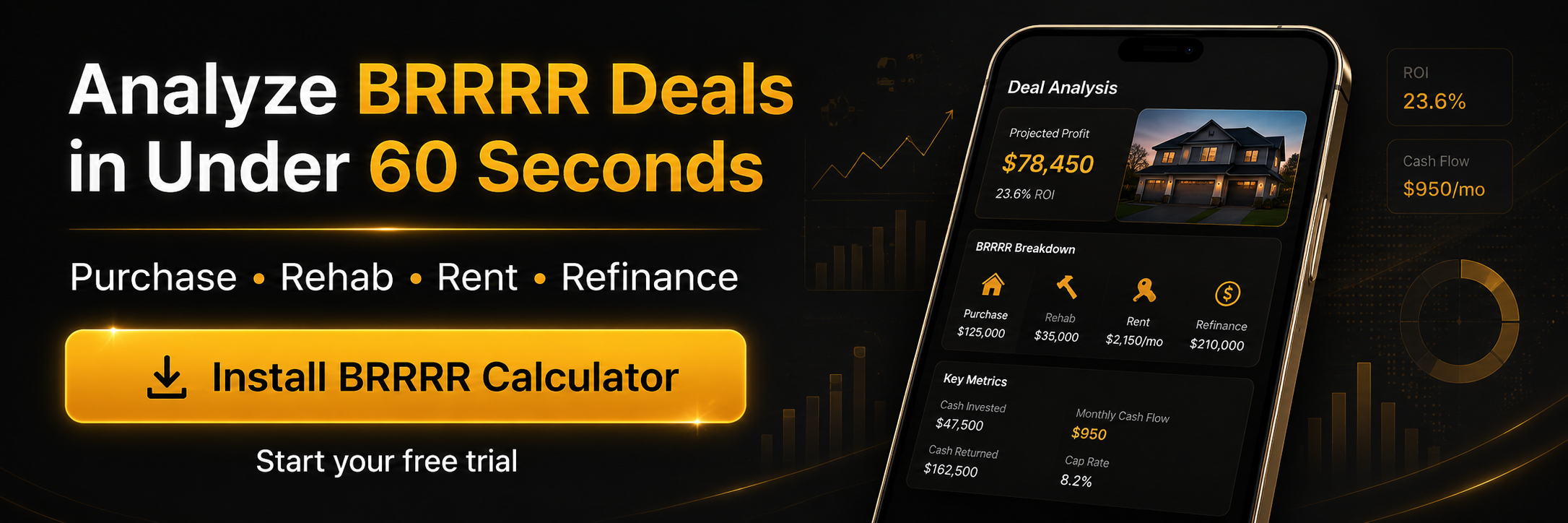
Doing all of these by hand in an excel sheet is possible, but it’s time-consuming, prone to mistakes, and can stall your deal process. The BrrrrSimply’s Analyzer performs all these calculations within 60 seconds with pinpoint accuracy.
Part 2: How to Analyze a BRRRR Deal
The formulas are only half the battle. The other half involves knowing how to analyze a deal in order, which experienced investors know how to do. Let’s see it.
How to Use ARV in Better Deal Analysis?
Your first step should not be to look at the asking price. It should be to determine your ARV. Look up comparable sales (comps) of the same size and fully renovated homes in the neighborhood.
Calculate Your Maximum Allowable Offer (MAO)
This MAO calculation ensures that you do not overpay.
MAO = (ARV × Lender LTV) − Rehab Costs − Desired Profit/Equity
Suppose if ARV is $150,000, lender financing LTV at 75%, rehab cost is $30,000, and you want $10,000 in equity cushion.
MAO = ($150,000 × 0.75) − $30,000 − $10,000 = $72,500
This is your maximum limit. Any amount above this reduces the profit margin for refinance recovery.
Get Your Rehab Numbers Right
It’s worth giving a lot of thought. Underestimating your rehab is the #1 mistake in BRRRR. Walk through the property with your contractor before committing. Break down each component: roof, HVAC, electrical, plumbing, cosmetic. Never rely on a single quote.
Rehab numbers can be broken down by experienced investors into the following.
Cosmetic (paint, flooring, fixtures): Lower cost with high impact on rent and ARV
Structural/Mechanical (roof, HVAC, plumbing, electrical): Higher cost but it’s crucial for appraisal and safety
Deferred maintenance: Needs work but won’t necessarily add value
Stress Test Your Rent Assumption
Your rent estimate is critical for your cash flow, which determines your cash-on-cash return. Get your comps from the market, with similar number of beds, baths, condition, and located between 0.5 to 1 mile radius. Be conservative. Take the low end of the rent range, not the high.
Your property that cash flows by $250 per month based on optimistic rents might just be break even.
Refinance Scenario Modeling
Speak to lenders before closing the deal. Understand their LTVs and seasoning requirements (some require 6-12 months of ownership), as well as the terms. The amount you get from the refinance is part of the monthly cash flow.
Run Full Deal Summary
Having obtained all your inputs, now run your BRRRR analysis that involve checking the following parameters.
Total all-in cost
Refinance proceeds
Cash left in the deal
Monthly cash flow after the new mortgage
Cash-on-cash return
Equity position
It’s great, if everything is checked. If not, go back and understand which input to negotiate further (purchase price or the extent of rehabs).

Part 3: What Makes a Good BRRRR Deal?
Below are few characteristics of a best BRRRR opportunity.
You Are Able to Buy Below Market Value
Core principle of BRRRR investing is that you make your profit while buying. You need to focus on distressed, off-market, or motivated seller deals, including foreclosures, estates sales, landlords who want to quit, and properties needing costly repairs scaring away average buyers. The maximum your initial discount, the better your refinance recovery.
The Rehab Creates Value, Not Just Expense
A good BRRRR rehabs are tactical. Each dollar spent on construction and materials should increase ARV, raise the rental value, or both. There is no need to over-improve, such as a luxury kitchen renovation in an average neighborhood rental market won't justify itself in appraisal.
Your Rent Supports Cash Flow Post-Refinance
This is one of the biggest mistakes made by BRRRR novices. They concentrate so much on recovering their money through refinancing that they fail to look at whether there will be enough cash flow after getting a new loan. This new mortgage payment must be able to accommodate itself into the cash flow structure.
ARV Supports the Refinance You Can Get
The difference between your all-in cost and your ARV needs to be enough so that the bank refinance your property. Otherwise, you will not be able to afford the monthly payments after the refinance.
The Market Has Rental Demand
A perfect fixer-upper in an area that lacks rental demand will be a cash flow disaster. Seek markets with low vacancy rates, employment gains, and steady or rising rents. Your tenant powers the entire strategy.
Little to No Cash Invested in the Deal
The best-case scenario is a total capital turnover where you are able to return 100% or even more than you invested. A situation where you leave 10-20% of your total investment in the deal is considered quite favorable if cash flow is good. Anything above 30-40% looks more like a normal rental purchase than a true BRRRR deal.
Part 4: What Cash-on-Cash Return Rate Should You Aim For in BRRRR?
Cash-on-cash return (COC) is one of the crucial performance indicators when it comes to real estate investing. It helps to determine what percentage rate of return you make each year based on the amount of money that was actually invested in the property.
How to calculate it?
COC Return (%) = Annual Net Cash Flow ÷ Total Cash Invested × 100
For example, if you invested $15,000 in the deal with an annual cash flow of $2,400, your COC return would be 16%.
What Should Be Your Cash-on-Cash Return in BRRRR?
It depends on many factors. However, here are the usual numbers that most successful BRRRR investors target.
Near-Infinite Returns
If you can pull off a near-perfect BRRRR where you take out 100% or more of your money, then your cash-on-cash return will be infinite. You have no money tied up in the deal, yet you are generating monthly cash flow from it. That is the magic of BRRRR strategy which the most investors pursue.
COC Return Can Be Deceiving in BRRRR
A key point to understand here is that if you put very little money into the deal, then your COC return will be incredibly high, even if your monthly cash flow is relatively small. If you have a deal in which you only left $1,000 in and make $100/month, then your COC return is 1,200% but $100/month doesn't really give you financial freedom.
This is why more seasoned investors pay attention to COC return and absolute monthly cash flow. You need both good numbers.
BrrrrSimply automatically computes both metrics for you, you're never left guessing about which metric really counts when it comes to your specific situation.
Part 5: How to Use ARV in BRRRR Deal Analysis
The After Repair Value (ARV) is the fuel of the entire BRRRR process. If done right, everything else will fall into place. If done wrong, no amount of flawless execution downstream will help you.
What Is ARV?
ARV is the estimated value of the property after completion of the entire renovation process. It does not reflect the present value. It’s neither the purchase cost of the property plus the cost of renovation. ARV is the fair market value that a licensed appraiser or a smart investor would put on the property in its renovated condition.
How to Determine the ARV
Extract Comparable Sales
Identify sales of similar properties (within 3–6 months ideally), with same size, bedroom/bath count, condition, and location. Ideally target properties within a radius of 0.5 to 1 mile from your subject property. In rural areas, you need to set the radius as far as 1 to 3 miles.
Adjust For Differences
You should adjust prices higher/lower based on:
Size of the house (price per sq. ft. is key here)
Condition (totally remodeled vs. partial remodel)
Larger lot, garage, finished basement
Proximity to desired amenities or disliked features
Set a Realistic Range
You should have three different ARV estimates, including a low, mid, and high ARV. Conduct your BRRRR calculation using the mid estimate. Ensure that the deal can be done using the low. If the deal only works at high, it is a warning sign.
How ARV Determines the BRRRR Refinance
Your lender orders the appraisal when refinancing starts. It is the appraised value and not your assumed value that determines the amount of money you can borrow. Therefore, it is important to be conservative with your assumptions on ARV. For instance, if you assume $160,000 ARV while the appraisal comes back at $140,000, then you are losing out a lot.
The additional $15,000 shortfall means an extra $15,000 of your own money is tied up in the transaction, which may make a better BRRRR into an average rental purchase.
ARV Safety Rule
An easy rule of thumb most BRRRR investors follow is that total cost of acquisition should not exceed 70-75% of ARV. It gives lender the permission to refinance you and keeps your equity intact.
All-In Cost ≤ ARV × 0.70
If the total cost is $105,000 and ARV is $150,000, then you will be exactly at 70%. If it exceeds 75% of ARV, then your refinance recovery will be compromised.
A Simple Example of How to Analyze a BRRRR Deal
To give you a deep insight of how to analyze a BRRRR deal, let's take an example and calculate the numbers.
Property – 3- Bed and 1-Bath Single Family House
After Refinance
This is the real thing. A full capital recycle, positive cash flow, and equity right out of the gate.
Final Words
The BRRRR method incentivizes those investors who know how to think before they fall for a property. Each process, from purchasing to refinancing, is closely related to each other. It means that if you analyze a BRRRR deal, you commit a mistake in any stage, it will have an impact all subsequent stages.
The best thing is that there's no need to spend much time and effort to perform the calculations correctly. The BRRRR Analyzer is developed by expert real estate investors who successfully closed over 2,500 deals and expanded a portfolio of 950+ units. It performs all necessary calculations within 60 seconds, from buying to refinance, cash on cash return, equity position, and much more.
Avoid mistakes. Know your numbers. Close deals with higher profit.