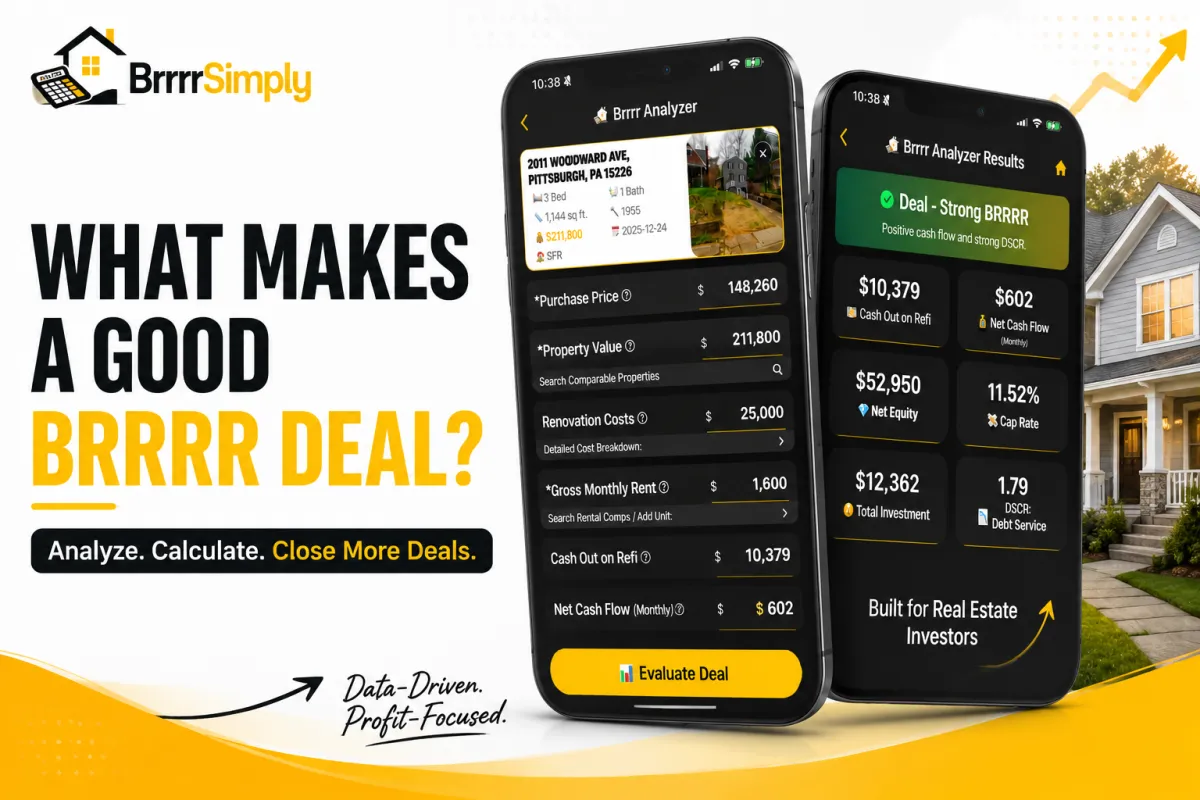
What Makes a Good BRRRR Deal?
Every experienced or novice real estate investor looks for a deal that pays for itself. The BRRRR (Buy, Rehab, Rent, Refinance, Repeat) provide this opportunity. How? It is a method to recycle the capital, develop a rental portfolio, and expand your business in a sustainable way without additional expenses.
However, majority new investors don’t know a fact that not every distressed property can qualify as a better BRRR deal. Choosing a wrong asset, overestimating its ARV, underestimating the costs required for renovations, ignoring the rental market research. Any of these actions will result in a property with low returns and a bad rental yield. So, what makes a good BRRRR deal?
The strategy only works when every piece of the puzzle fits. Buy wrong, overestimate the ARV, misjudge the rehab costs, or skip the rental market analysis, and you’ll find yourself with a property that ties up your capital and delivers disappointing returns. The BRRRR method rewards precision, not guesswork.
There are six signs to look for. If a property checks all six boxes, you have found your best BRRRR deal. If it misses on more than one, it's time to walk away.
Sign #1: You Can Purchase Significantly Under Market Value
With BRRRR investing, you make the money on purchase. It is the refinance that enables this, but the discount is the key part of the equation. Without a discount, there is no way the numbers will add up enough to allow you to recover capital during refinance.
A good BRRRR deal often involves distressed sellers/off-market real estate. Foreclosure, estate, tired landlord, and repair properties that scare off buyers fit the bill. Your purchase price needs to be well under market value in order to give you enough space to cover the costs associated with renovating the property, holding it, and getting refinanced.
Your total cost including purchase price, rehab, carrying costs, and closing fees should not exceed 70%-75% of ARV. This is where your margin lies, and if the price is higher, then it becomes hard to work with.

Sign #2: The Rehab Increases Value, Not Just Cost
Property rehab establishes the foundation of the BRRRR process. If done right, the renovation will increase the appraised value of the property, as well as its rental appeal. A poorly performed rehabilitation can suck your money without delivering any benefit at all.
If you are doing things right, your investment in rehab for your BRRRR should make your ARV or your rental rate go up. Usually, cosmetic renovations like paint, flooring and fixtures provide an excellent ROI and are relatively inexpensive. Structural and mechanical work is costly, but often necessary for appraisal and for the safety of your tenants.
Remember over-improvement is a red flag. Installing a top-of-the-line kitchen in a blue-collar area won’t improve your appraisal. Experienced investors create scopes of work that fit the market, and nothing more. Always walk your property with your general contractor, break down the costs of the rehab into individual components, and leave some extra room for emergencies.
Sign #3: Strong & Stable Local Rental Market
Even the best property rehabs could still generate cash flow problems depending on the rental market conditions. For a good BRRRR deal, you need a market that has a constant demand by tenants. The vacancy rate should be minimal, and the rent should be stable and growing with high-quality tenants easily available.
Market research must be done before deal execution to understand the key dynamics, such as job stability and growth rate, population and vacancy, and days on market for similar properties. A market with better job base and growing population rate is a perfect place for BRRRR investment.
When calculating rental costs, you should always assume worst-case scenarios. Find comparable rentals within a radius of 0.5-1 mile that have the same number of bathrooms and bedrooms. Use the lower side of the rent range, not the upper side.
Sign #4: The ARV Supports a Full or Near-Full Refinance
Your ARV is your most critical number when evaluating a BRRRR investment. ARV does not reflect your best guess for how much the property will be valued. Instead, it reflects the exact market value, determined by an independent appraisal, of a home in its post-renovated condition.
What makes a good BRRRR deal is that you should have an After Repair Value that allows a lender to do a full or near full refinance at 70-75% LTV which can fund most, if not all, of your cash to close expenses. If your appraisal comes back lower than expected, then the money you lost on your ARV gets stuck in your deal.
Always evaluate your BRRRR on three After Repair Value estimates, including conservative, mid-range, and optimistic. Then use your middle range number for all other calculations. You need your BRRRR investment to work in a moderate range, otherwise, the slightest miscalculation in your appraisal could turn a good BRRRR into a mediocre rental investment.
Sign #5: The Numbers Make Sense Even After the Refinance
The most common mistake in BRRRR investing is to concentrate only on recovering the initial investment capital, while overlooking what will happen to the monthly cash flow after you have refinanced the property. After completing a cash-out refinance, you are actually creating yet another monthly expense that needs to be accounted for in terms of the income generated by the property.
Before moving forward with the deal, conduct a thorough post-refinance cash flow analysis. This includes calculating the monthly net income after deducting the mortgage payments, property taxes, insurance, management fees, vacancy reserve, maintenance and cap-ex.
If you manage to recover all of your capital from the initial purchase but have barely $50 left for your pocket, then you have completed a full BRRRR cycle. However, this leaves very little room for any mistakes. Experienced investors always aim for at least $150 - $200 per door per month.
Sign #6: Minimal or No Capital Left Tied Up After BRRRR Refinance
This sign distinguishes a good BRRRR deal. You want minimal amounts of capital left tied-up after completing the refinance. A preferred outcome is a full return on capital (return equals 100%), or an infinite return (return > 100%), meaning that the amount borrowed during refinancing fully covers your all-in cost.
Even if there is 10-20% left tied up in this deal after refinancing, it still can be viewed as a successful BRRRR strategy because there is healthy cash flow and/or substantial equity in the project. When 30% to 40% or even more capital remains tied up, this approach becomes more like buying rental properties outright rather than capital recycling.
Calculate this measure using Cash Left in Deal calculation.
Cash Left in Deal = All-In Cost − Amount Borrowed During Refinance
When this results in 0 or less, capital was fully recycled. When it's relatively low compared to other figures, you're good. Otherwise, go back and negotiate purchase price down or reduce the size of renovations.

Final Words
A best BRRRR investment doesn’t just mean buying an inexpensive home. It means buying a home that gives you capital recouping, cash flow, and scalability due to a discounted purchase price, appropriate level of renovations, strong rental potential, high ARV, and favorable refinance terms.
When all six signs point towards a positive, that’s what makes a good BRRRR deal. If some are lacking, then you’ve got a deal that needs reworking. And if nothing adds up in your fundamentals, you know when to move on and come back later.
BRRRR investors with big portfolios aren’t just working hard but doing their analysis right. Test every deal you look at using the BrrrrSimply BRRRR Analyzer for all six criteria in under a minute.